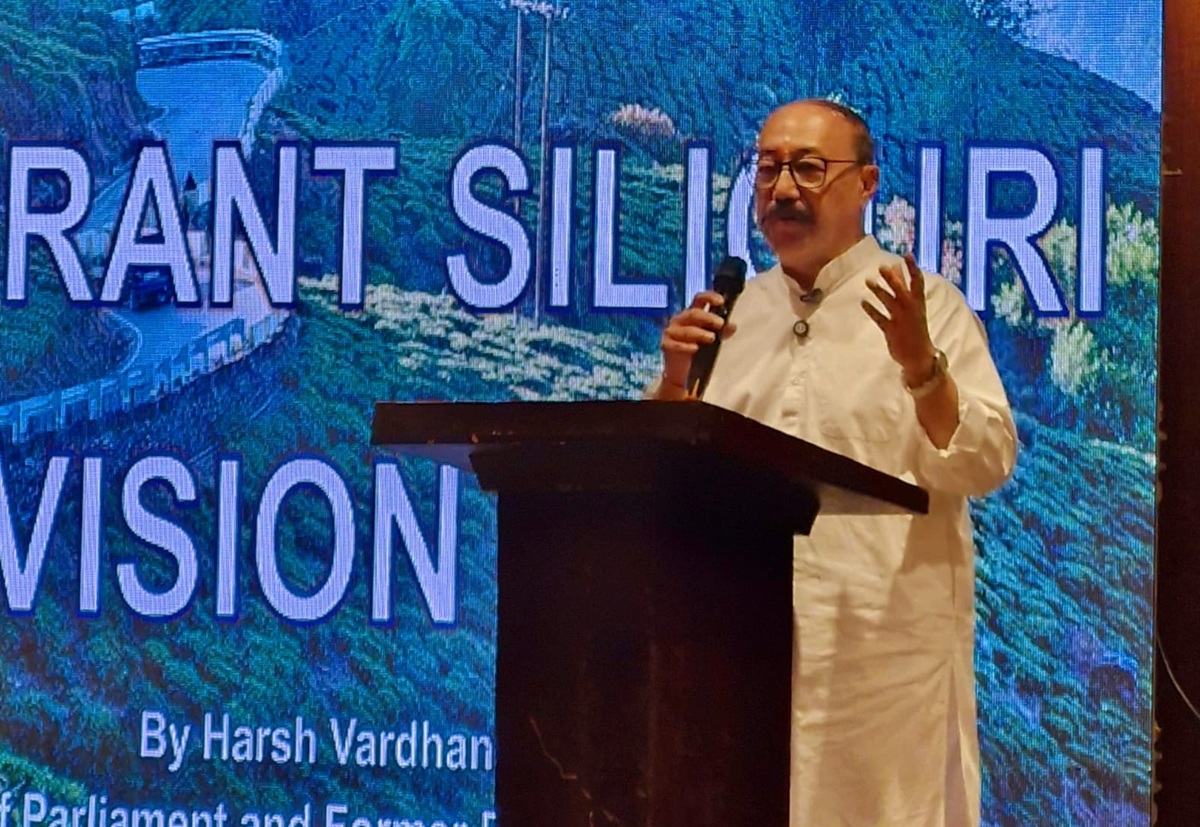
Member of Parliament and former Foreign Secretary Harsh Vardhan Shringla today unveiled “Vibrant Siliguri – Vision 2047,” a business-focused development blueprint aimed at repositioning Siliguri from a strategic transit corridor into a national hub for growth, connectivity and innovation. The vision was presented at Hotel Highland on Sevoke Road at a programme organised by the Siliguri Citizens’ Forum, attended by policymakers, industry leaders, civil society representatives and citizens.
Highlighting Siliguri’s commercial advantage, Shringla highlighted its role as India’s gateway to the North East and its proximity to Nepal, Bhutan, Bangladesh and China. This geographic edge, he said, places the city at the heart of India’s Act East Policy, Neighbourhood First approach and Indo-Pacific outlook, strengthening its case for accelerated investment.
The vision document outlines priority interventions across infrastructure, education, healthcare, urban mobility and border management. Proposals include setting up a central university and institutions of eminence to create a skilled talent pipeline for industry, alongside AIIMS-level healthcare infrastructure to reduce North Bengal’s dependence on Kolkata for advanced medical services.
To support rapid urban expansion and logistics efficiency, the roadmap proposes smart city solutions, an MRT-based underground transport system, elevated corridors to safeguard forest ecosystems and wildlife movement, and cable-car connectivity linking Siliguri with Kurseong and Mirik measures aimed at improving mobility while lowering carbon impact.
The programme also cited central government investments such as highway upgrades, NJP railway station modernisation, Bagdogra Airport expansion and nationwide welfare schemes as key enablers of growth. Addressing the gathering, Shringla said Siliguri’s geography offers destiny, but vision and decisive action will drive direction and returns well before 2047. Rajya Sabha MP Sangeeta Yadav described Siliguri as a “Mini India” and stressed that North Bengal should not have to wait until 2047 to realise its full economic potential.